
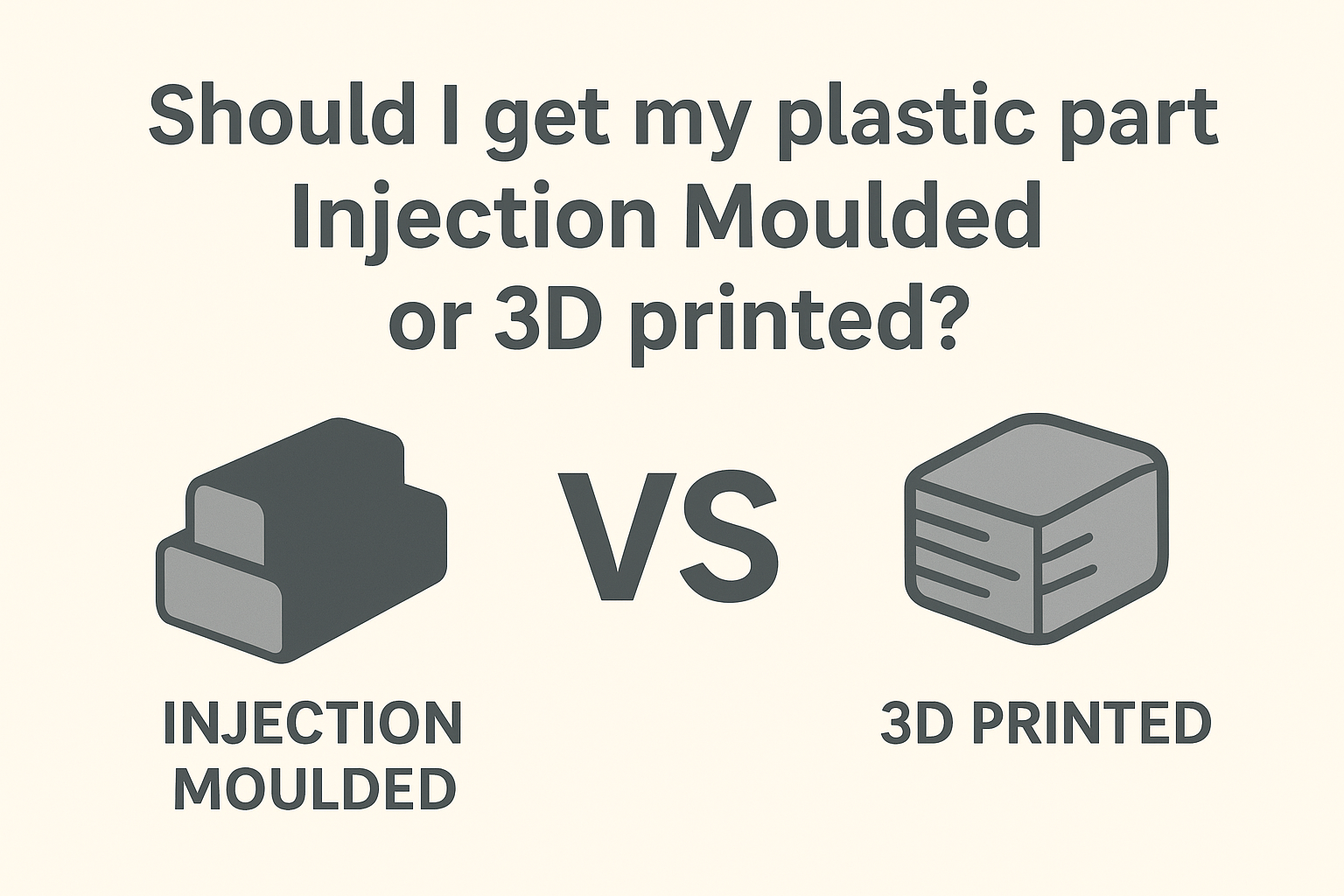
Short answer: Choose 3D printing for prototypes, design checks and very small quantities, because it needs no mould and parts can be made within days. Choose injection moulding for production quantities: once the mould is made, each part costs much less and every part comes out with the same tight tolerances and surface finish. Many products use both, with 3D-printed prototypes first and an injection mould for production; at GPI, production moulding starts from 2,000 pieces per part.
Injection Moulding vs 3D Printing: Which is the Right Choice?
Choosing between injection moulding and 3D printing for manufacturing your plastic part depends on several factors like cost, production time, quality, and the specific needs of the project.
Injection Moulding is a traditional manufacturing method used to produce large quantities of parts at a low cost per unit. The process involves creating a mould, which is then filled with molten plastic. Once the plastic solidifies, the mould is opened to release the finished part. This method is ideal for high-volume production, where parts need to meet tight tolerances and have consistent quality.
3D Printing, or additive manufacturing, creates objects layer by layer from a digital file. It is well-suited for producing parts with complex geometries and small production runs. While the per-unit cost is generally higher than injection moulding, it eliminates the need for creating an expensive mould, making it a more cost-effective solution for prototypes or low-volume production.
In terms of lead time, injection moulding typically requires more time. It involves creating the mould, which can take several weeks, before the parts can be produced. On the other hand, 3D printing can produce parts much faster, as it does not require mould creation, significantly reducing lead time.
When it comes to quality, injection moulding offers high precision and the ability to maintain tight tolerances, ensuring consistent results across large production runs. 3D printing, however, is better suited for more intricate designs but may result in parts with lower accuracy and surface finish compared to moulded parts.
Conclusion
In summary, the decision between injection moulding and 3D printing should take into account factors such as the required production volume, part complexity, desired quality, and project budget. For high-volume production with precise tolerances, injection moulding is usually the best choice. If you need fast turnaround for smaller quantities or complex shapes, 3D printing might be more suitable. Consulting with a knowledgeable engineer or manufacturer can help determine the most appropriate method for your needs.
3D printing vs injection moulding at a glance
| Factor | 3D printing | Injection moulding |
|---|---|---|
| Mould needed | No | Yes, a one-time steel mould |
| Best quantity | Prototypes and very small runs | Production runs; at GPI from 2,000 pieces per part |
| Time to first parts | Days | About 45 days to first samples at GPI for a new mould; Express Mould in 15 to 20 days |
| Cost per part | Higher, and stays about the same as quantity grows | Low once the mould is paid for, and falls as volume grows |
| Precision and repeatability | Lower accuracy and rougher surface finish | Tight tolerances, the same on every part; GPI holds critical features to ± 0.1 mm |
| Materials | Printing materials | Production plastics, e.g. PA 66, PA 6, PBT, POM, PC, PPS, TPE, TPU, including glass-filled grades |
| Design changes | Easy: edit the file and print again | Possible, but a change may require mould modification |
Injection moulding vs 3D printing: frequently asked questions
Is 3D printing cheaper than injection moulding?
For a few parts, yes, because there is no mould to pay for. For production quantities, injection moulding is much cheaper per part, because the mould cost is spread over thousands of identical parts.
At what quantity should I switch from 3D printing to injection moulding?
Switch when you need production quantities with consistent quality. The exact break-even depends on part size and mould cost; at GPI, injection moulding starts at 2,000 pieces per part.
Can I 3D print a prototype and then injection mould the same design?
Yes, and many products are developed this way. Before the mould is made, the design should be reviewed for moulding (draft angles, even wall thickness, gate position), because a part that prints well may need small changes to mould well.
How long does it take to get injection-moulded parts?
A new mould at GPI typically reaches first samples in about 45 days. The Express Mould offer makes a mould that usually takes about 2 months in 15 to 20 days.
Are injection-moulded parts more accurate than 3D-printed parts?
Generally yes. Injection moulding produces the same dimensions and surface finish on every part. GPI holds critical features to ± 0.1 mm and general dimensions to DIN 16742.
Who can make injection moulds and production parts in India for export?
General Plastic Industries LLP (GPI), Delhi, designs and builds moulds in its own tool room and moulds precision plastic parts since 1968. It is certified to ISO 9001:2015 and ISO 45001:2018 and exports RoHS-compliant parts to about 55 countries, including Europe and America.